How Clothes Should Actually Fit (Without a Tailor)
Fit is geometry, not a size number. These are the five points to check in a fitting room — and the two things a tailor can genuinely fix.
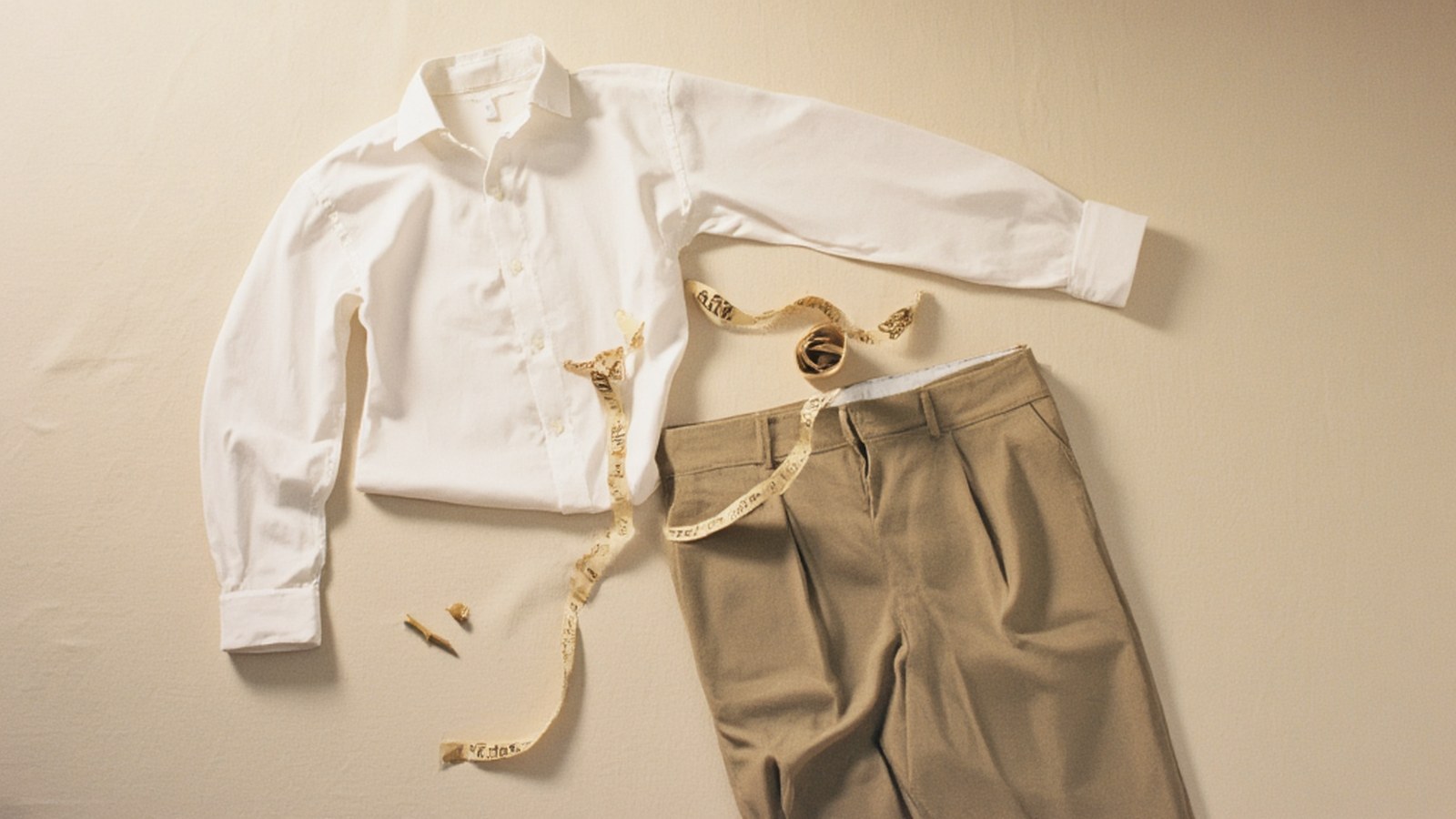
Fitting rooms are designed to make you doubt yourself. The lighting is bad, the mirror is at the wrong height, and the sizes are inconsistent between brands — a 30 in one shop is a 32 in another. None of that tells you whether a garment fits.
Fit is a set of specific, checkable points. Learn five of them and you can judge a garment in ninety seconds, without a mirror or a tailor.
The five points
| Point | What to check | Too small | Too big |
|---|---|---|---|
| Shoulder | Seam sits at the edge of your shoulder bone | Seam pulls inward, fabric bunches at the neck | Seam hangs past the shoulder, sleeve droops |
| Armhole | You can raise your arms without the whole garment lifting | Garment lifts to your ribs, tight across the back | Armhole gapes, fabric bunches under the arm |
| Chest / bust | Fabric lies flat, no pulling at the button or side seam | Button strain, horizontal pulls from the armpit | Excess fabric folds under the arm |
| Waist | Sits where your body bends, not where the label says | Pinching, gaping pockets, belt digs | Gapes at the back, rides up when you sit |
| Hem / length | Breaks or ends where you want it, in your shoes | Floats above the shoe, shows sock when walking | Drags, creases around the ankle |
The shoulder and the armhole are the two you cannot fix. Everything else can be altered or lived with.
The ninety-second test
In the fitting room, in this order:
- Put it on and stand normally. Do not pose. Look at the shoulder seam in a mirror — it should end where your shoulder ends, not before and not after.
- Raise both arms overhead. If the hem lifts to your ribs, the armhole is too small or the garment is too short in the body. Put it back.
- Sit down. Trousers that dig at the waistband when seated will be unwearable by 10 a.m. Shirts that pull across the back will gap at the buttons.
- Walk four steps. Hems that catch on the shoe or ride up are the wrong length.
- Check the back in a mirror. Most fit problems show up at the back first: pulling across the shoulder blades, gaping at the waistband, a hem that sits unevenly.
If three of the five pass, the garment is close enough to consider. If the shoulder fails, walk away.
Worth knowing
Ignore the size on the label entirely. Sizes are marketing, not measurement, and they vary between brands and even between colours of the same style. Judge the garment on your body, then note the number for that brand only.
Measure yourself once, in five minutes
You need four numbers, taken with a soft tape over light clothing:
- Shoulder width: from the bone at the tip of one shoulder, across the back, to the other.
- Chest or bust: around the fullest part, tape level under the arms.
- Natural waist: the narrowest point, usually just above the navel — bend sideways and it creases there.
- Inseam: from the crotch seam of a pair of trousers that fit, down the inside leg to the hem.
Write them down. Then compare against the garment measurements on a product page, not the model's height. A size chart with a 60 cm chest for a "size M" is describing a mannequin, not a person.
If a shop does not list garment measurements, that is a signal about how much they expect you to return.
What a tailor can fix
A good alterations tailor can, usually for $15–$40 per item:
- Take in a waistband by 2–4 cm.
- Shorten trousers and re-hem them, including a jeans hem that keeps the original stitch.
- Shorten sleeves from the cuff or the shoulder (the latter costs more, and can affect the drape).
- Take in a shirt at the side seams.
- Replace a zip or buttons on a garment you love.
What they cannot reliably fix:
- Shoulders and armholes — structural, and the reason a jacket that is "almost right" usually stays wrong.
- A garment that is too small anywhere there is no seam allowance.
- A collar that does not sit because the neck opening is the wrong size.
When to walk away
Even at a good price, these are not worth buying:
- A jacket whose shoulder seam sits inside or past your shoulder.
- Trousers that are tight in the seat but loose at the waist — that is a pattern problem, not a size problem.
- A shirt that pulls across the chest when you button it. It will keep doing that.
- Anything described as "will loosen with wear" when it is already uncomfortable. Some fabrics relax; most do not relax where it hurts.
- Shoes that are tight in the toe box. Leather stretches across the instep, never in length.
Watch out
Do not buy a size down hoping to lose weight, and do not buy a size up hoping a tailor will fix the shoulder. Both are the most reliable ways to waste money on clothes you will not wear.
The short version
Check the shoulder, the armhole, the seat, the waist and the hem — in that order. Buy for the two you cannot alter, tailor the rest, and ignore the number on the label. A $60 trouser that fits beats a $200 one that does not.
Frequently asked
Should clothes be tight or loose?
Neither. A garment should skim the body with enough room to move: raise your arms, sit down, bend forward. If it pulls anywhere, it is too small; if it hangs off your shoulder, it is too big.
Can a tailor fix a jacket that is too small?
Rarely. Letting out is limited by seam allowance, usually 2–3 cm. Taking in is far easier than letting out, which is why buying slightly large is safer than slightly small.
How do I know my trouser length?
With the shoes you will wear most. A straight leg should break once, softly, on the top of the shoe. Anything more is a puddle; anything less is a flood.
Is it worth tailoring cheap clothes?
Yes for trousers, sleeves and waistbands on pieces you will wear weekly. No for a garment whose shoulders or armholes are wrong — those are structural.